Kunos Simulazioni are working hard to include as varied a vehicle roster in its developing Assetto Corsa Evo title as possible, with many of the world’s most prolific brands already featured. These include Ferrari, Lotus, and Porsche. Another important brand when it comes to maximising vehicle performance is BMW, which creates usable performance weapons that the masses can jump in and enjoy on the road or track.
A total of seven of the Munich-based brands’ cars already feature in AC Evo, so Coach Dave Academy decided to explore what it has to offer.
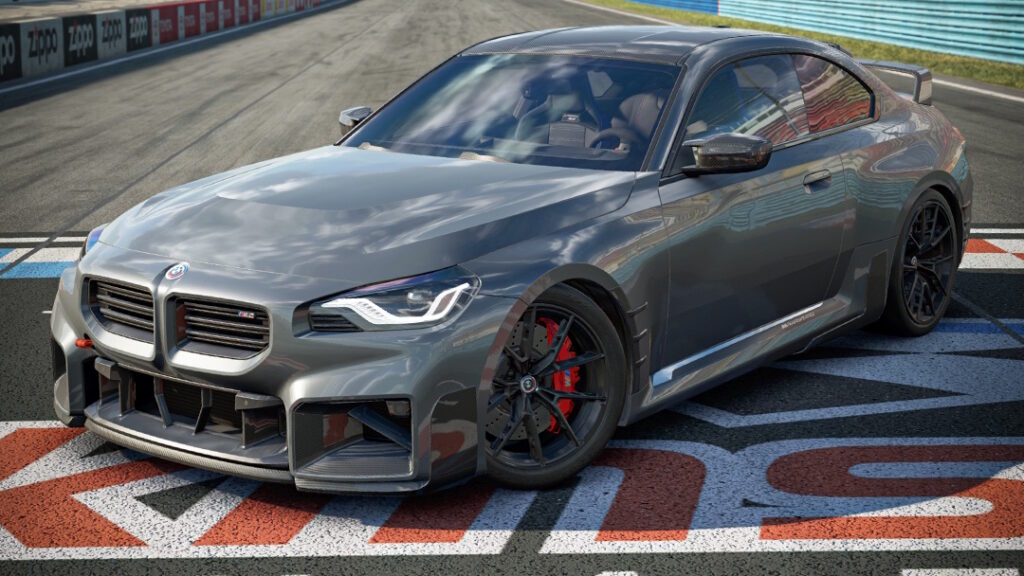
BMW M2 G87 Coupe
We start with a vehicle freshly added to AC Evo in the recent 0.5 build of the game, the BMW M2 Coupe.
Released in 2023, the G87 version of the M2 comes loaded with the same 3.0-litre twin-turbo straight-six engine found under the hood of the previous-gen M2 Competition and CS models. As with most BMW performance models, the unit sends its 453 horsepower to the rear wheels. It can be had with either a traditional six-speed manual gearbox or a slicker and more modern eight-speed automatic unit.
The M2’s more compact build ensures that it’s more agile and feels more visceral than its larger siblings, making it a more engaging and exciting prospect as a result. That said, its wheelbase measures just over two inches longer than that of its forerunner, a change made to bring a little more stability to proceedings.
The car coming to AC Evo is the updated 2025 version, which comes with 473 hp to enjoy, as well as a slightly revised interior. To explore the other cars currently featured in AC Evo, check out Coach Dave Academy’s full car list for the title.
BMW M2 CS Racing
The M2 CS Racing is the racing version of the first-gen M2 road car, and was designed to primarily compete in BMW’s own one-make racing series. Alongside this, the car was also eligible to race in various multi-class fixtures, such as the Nurburgring Nordschleife-based VLN and NLS series, and the IMSA VP SportsCar Championship.
While featuring the same base twin-turbocharged 3.0-litre engine as its road-going counterpart, it was modified to produce up to 450 hp in its most powerful form. Most series use Balance of Performance to reduce the peak engine output, with 365 hp being a common setting. Alongside the altered engine, the M2 CS features a strengthened rollcage to conform to various safety regulations, as well as adjustable suspension and aero.
The car is set to soon be replaced by a new version based on the G87 M2.
BMW M3 E30 Sport Evolution
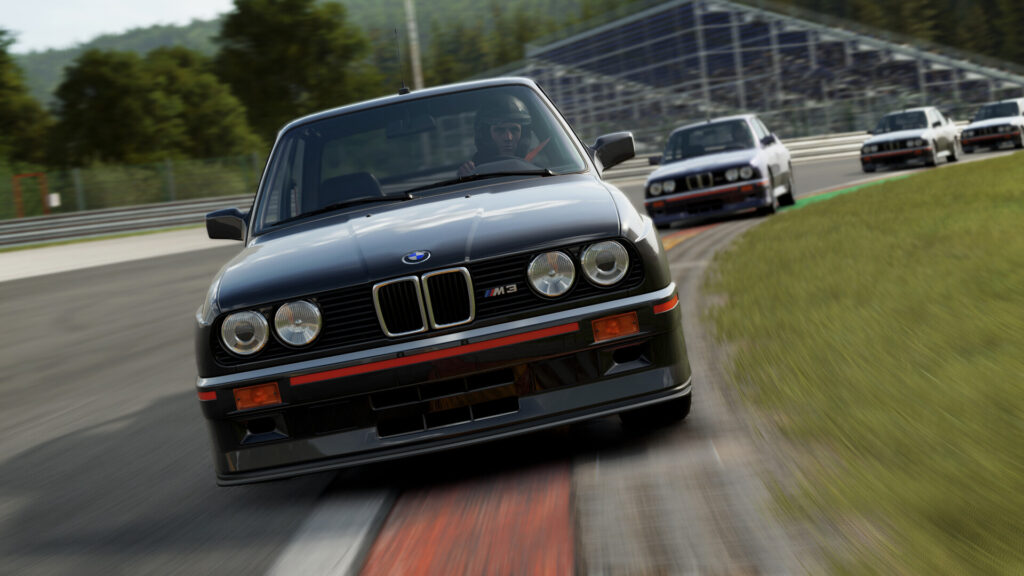
The BMW M3 E30 is one of the most legendary performance cars ever produced, with the vehicle being one of the first to prove that sports car levels of pace didn’t have to mean impractical.
Featuring a high-revving naturally aspirated four-cylinder engine, the E30 won over drivers around the world for its approachable and balanced handling. BMW reluctantly unleashed the M3 so that it could make a racing version of its 3-Series, though buyers loved it and ultimately turned it into a huge sales success.
The rear-wheel drive machine was gradually refined during its production run, with the most commanding of the lot being the Sport Evolution. Unveiled in 1990, the SE saw the car equipped with a revised 2.5-litre engine that kicked out 238 hp, as well as adjustable front and rear aero devices. The machine was built so that BMW could upgrade the Group A racing version of the M3, as it needed to build a select number of road-going versions to clear homologation. This is the car you’ll get to enjoy in AC Evo.
Just 600 examples of the ultimate E30 M3 were built, so AC Evo is one of the best places to sample it for yourself.
BMW M3 E46 CSL
BMW continued to up the ante with every M3 following the initial E30 version, and the E46 was the third instalment. Based on the E46-gen 3-Series, the range-topping M3 was released to the public in late 2001. Equipped with a new 3.2-litre straight-six engine, the M3 was now producing 338 hp, around 100 hp more than the ultimate E30 could muster. It was also heavier, but its widened track and highly tuned modern independent suspension layout made up for it.
In 2003, BMW decided to make the ultimate version of the E46 M3. Named the CSL, BMW tasked its M Department with stripping out as much weight as possible. It managed to strip out nearly 250 pounds from the standard car, with this achieved by making the roof from glass-reinforced plastic, the boot from fiberboard, and the body panels from carbon fibre. Alongside the M3’s diet, the engine was also tweaked to produce an extra 20 hp, while the transmission and suspension were sharpened up.
The result was a driver-focused machine that featured little in the way of compromise, which makes it an excellent option for taming the world’s best racetracks – or perhaps the roads around the outside of the Nordschleife. In keeping with the CSL nameplates’ limited nature, just 1,383 examples of the car were made.
If you want to learn about how to look around your potential new BMW within AC Evo, check out Coach Dave Academy’s comprehensive garage guide.
BMW M4 CSL
The M4 CSL is to the M4 what the old M3 CSL was to the M3. The M4 essentially became the M3 coupes’ successor once the latter was transitioned to become a four-door sedan-only offering. Built to celebrate the 50th anniversary of the BMW M Division, the M4 CSL was a hardened and more powerful version of the standard car.
Its 3.0-litre twin-turbo straight-six was enhanced to create 543 hp, around 70 hp more than the base M4. Its eight-speed automatic transmission was also breathed on to afford even slicker and faster gear changes, which ensured it could give proper supercars a run for their money, courtesy of a 3.6-second 0-60 mph sprint time.
The vehicle also went on a diet that saw 200 pounds lost, while carbon fibre front and rear devices were brought along to help produce downforce and increase high-speed grip. The result of these tweaks, as well as an advanced adaptive suspension system, led the car to post the fastest ever time for a BMW road car around the Nordschleife, a 7.18.137s.
The M4 CSL was even rarer than the E46 M3 CSL, with just 1,000 units being produced.
BMW M4 GT3 Evo
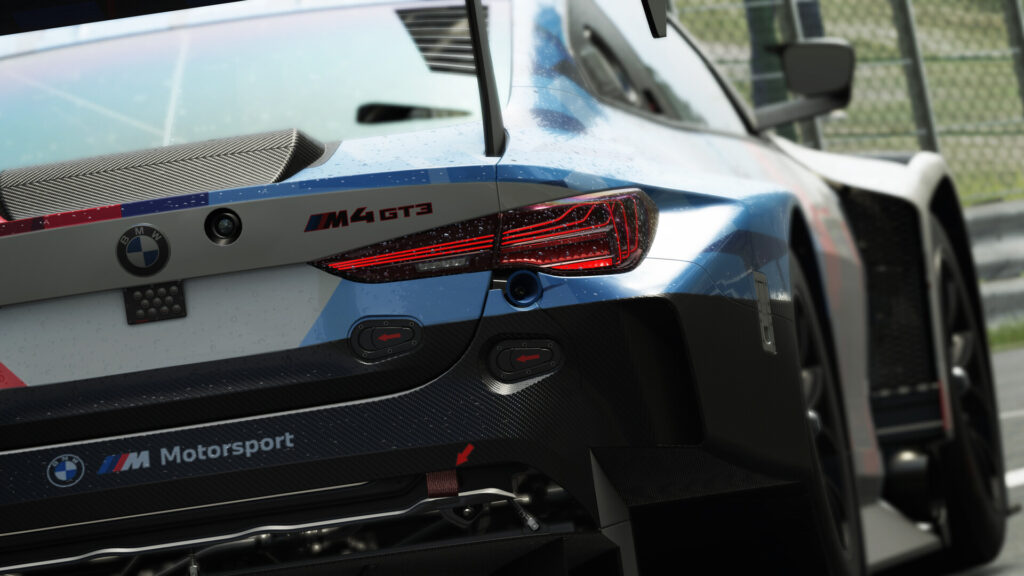
BMW’s M4 GT3 managed to achieve over 70 victories worldwide between 2022 and 2025, so finding ways to improve it on the face of it would seem pretty tricky. BMW managed it, though, and it introduced an Evo version of the car for the 2025 motorsport season. It retained the same twin-turbo 3.0-litre I6 engine as the first variation, but got a refreshed aero package to help produce more downforce.
This increased high-speed grip and stability to make it more approachable for less-experienced gentlemen drivers. Alongside this, its foundations were tweaked to help improve tyre wear, as well as reliability over longer distances. Being a GT3 car, the M4 GT3 Evo comes with fully adjustable aero and suspension, as well as driver aids like TC and ABS.
The improvements were clear to see from its first campaign, with titles being secured for the car in the IMSA Michelin Sports Car Championship’s GTD Pro class and GT Challenge Europe’s overall and sprint cup fixtures. It also scored victories in demanding encounters such as the Nurburgring 24 Hours and Bathurst 12 Hours.
BMW M8 Competition
The M8 is BMW’s softer and more luxurious model, designed to go up against the likes of the Aston Martin DB11 and Mercedes-AMG GT. It was developed to bolt down the motorways of the world as quickly as possible, but while also ensuring its occupants feel like they’re travelling along in a five-star hotel.
For drivers looking for a more exciting drive, BMW unveiled the Competition of the car in 2019. It came boasting a breath-on version of the twin-turbo 4.4-litre V8 featured in the standard machine, which saw peak power rise from 591 hp to 625 hp. It also comes with racier interior fittings and M Division-developed carbon ceramic brakes. Its adaptive suspension setup was also tweaked to produce a stiffer and more pointed handling balance.
It retained the BMW xDrive all-wheel drive system found in the normal M8, with the setup notable for allowing full disconnection of the front wheels to allow for full rear-wheel drive action if desired. This meant you could trade optimal grip for a bit of sideways action, depending on your mood.

Setup IQ, AI Coaching, Telemetry Data, Leaderboards, Never Lift and Video Analysis - all in Delta for Le Mans Ultimate, iRacing, ACC and AC Evo. Everything you need to win and get faster as a driver in one subscription.