
As we power through the 2026 iRacing special event calendar, one of the most challenging events on the iRacing special events calendar approaches – the mighty Nurburgring 24 Hours.
The Nurburgring 24 Hours is one of the world’s most unforgiving circuits, held at the fearsome 25.3-kilometre Nordschleife circuit. Unsuspecting drivers are at the mercy of the unpredictable weather conditions that stalk the Eifel Mountain region of Germany, which could affect only a small section of the huge venue at any one time.
With entries made up of GT3, GT4, TCR, and Porsche Cup categories, you will also have to navigate multi-class racing on top of the already challenging stage that is set.
When Is The Nurburgring 24 Hours Held?
The iRacing Nürburgring 24 Hours typically takes place two weeks before the real-life event. In 2026, the iRacing special event will be held over the May 1-3, 2026 weekend as the real Nürburgring 24 Hours takes place May 14–17, 2026.
Typically, series within iRacing, such as the IMSA or Simucube Sprint, will bring drivers to the Nürburgring on the week of the 24 hours, allowing you to practice before the main event.
When Are The Nurburgring 24 Hours Race Times?
iRacing sets up multiple splits so that wherever you are in the world, there’s always a time slot that fits your schedule.
- Late Friday GMT: ideal for drivers in North and South America, as it falls during the daytime in those regions.
- Early Saturday morning GMT: best for drivers in Asia and Australasia, running during their daytime hours.
- Saturday 12:00 GMT: this is the main event. The top split is broadcast live, so it’s also the one to watch if you’re spectating. It will be the most heavily populated split, so less experienced drivers may want to consider one of the quieter time slots.
- Later Saturday splits: useful if you suffer a technical issue or crash out of an earlier race, giving you a second chance to complete the event.
The race runs as a team event with a minimum of two drivers per team and a maximum of 16.
What License Is Needed To Race in the Nurburgring 24?
You need a minimum D-level road racing licence with a safety rating of at least 4.0 to enter. If you hold a C licence or higher, any safety rating qualifies.
Your licence level doesn’t determine your split; however, that’s decided by your team’s combined road iRating. So you could share a server with higher-rated drivers on a lower licence class, or vice versa.
Reaching a D licence is straightforward. Clean, consistent finishes in rookie series like the Global Mazda MX-5 Cup, Formula Vee, or Formula 1600 will get you there quickly. And the extended format of a 24-hour race is actually a great opportunity for safety rating gains. A single clean race can jump you multiple licence levels if you stay consistent throughout your stints.
If you’re not quite at the required licence level yet, Coach Dave Academy’s licence guide can help you get there before race day.
What Is The Nürburgring Nordschleife?
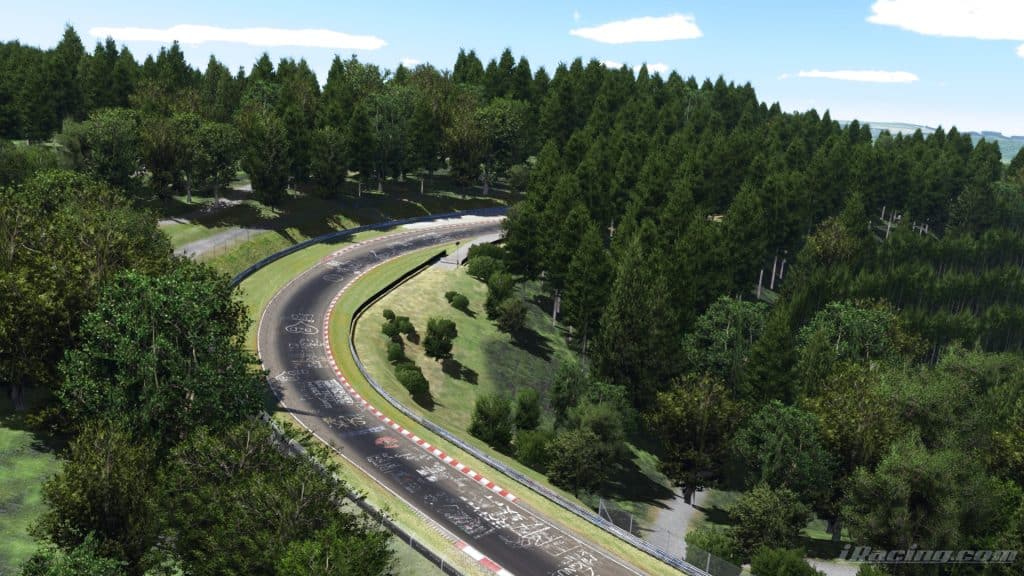
The Nurburgring Nordschleife – especially when in its 24H configuration, which combines the Nordschleife with the GP circuit designed for Formula 1 racing – is one of the longest and most revered strips of tarmac in the world.
The twisty layout contains an immense 170+ corners, all of which have their own character that demands a lot from both driver and machine. The first part of the circuit, which takes place on the GP loop, is by far the easiest with its sweeping turns and large runoffs.
Reality hits quickly, though, as you pull off onto the Nordschleife after tackling the high-speed chicane at the end of the GP section. Suddenly, the run-off disappears, replaced only with narrow strips of grass and endless stretches of metal Armco barrier that waits patiently for its next victim.
The first half of the venue is generally more stop-start, though the terrifyingly quick ‘Schwedenkreuz’ left curve can easily catch you out should you run slightly wide on entry.
The bravest drivers can try and make a move on the long run from Bergwerk up to the iconic Karusell. A steeply-banked 180-degree bend, it presents an extra challenge as it has a concrete surface, which affords the driver less grip than the tarmac and is also ultra-bumpy.
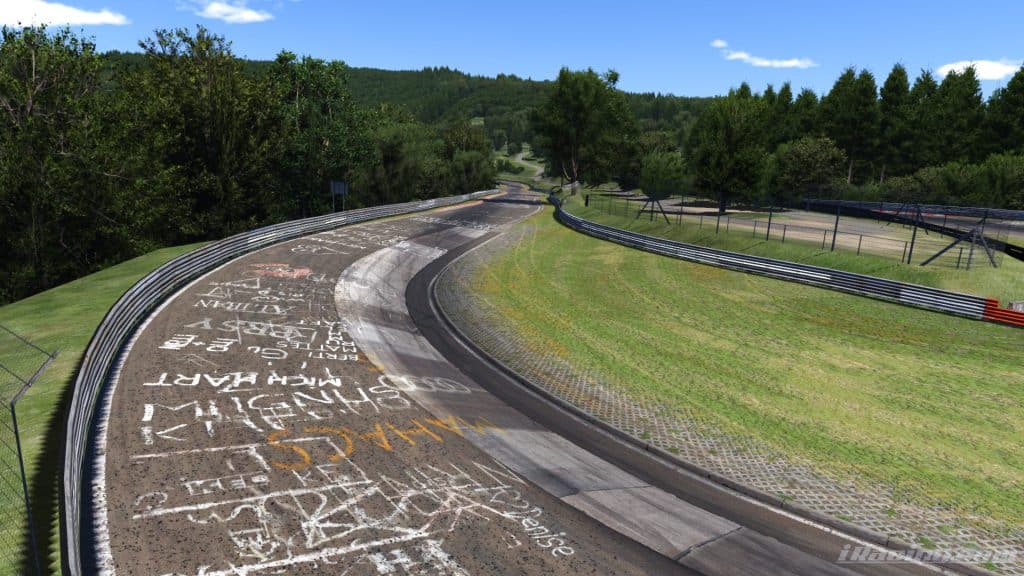
The corner also represents a rhythm change for the rest of the track, with the final sector before the two-kilometre Dottinger Hohe being made pretty much exclusively of high-speed turns that demand huge commitment from the driver. The Dottinger represents the best overtaking opportunity of the entire circuit, due to the huge slipstream effect the car ahead gives off.
- For a full rundown of a lap around the Nurburgring Nordschleife 24h layout, why not check out a hot lap of the circuit by one of Coach Dave Academy’s professional drivers?
The Cars Eligible for the iRacing Nurburgring 24
The Nurburgring 24 Hours is structured as a multi-class event that utilises the GT3, GT4, TCR, and Porsche Cup.
The GT3 Class
The GT3 class at the Nurburgring 24 Hours is made up of all GT3 cars on the iRacing roster. The cars have traction control and ABS, which gives drivers a safety net should they apply the throttle or brake that bit too hard.
They also feature a large amount of downforce, meaning they feel great in high-speed bends as well as in slower turns due to these vehicles being set up softer than prototypes, for example. Their performance is equalised by iRacing’s Balance of Performance (BOP) system.
- Need to know which GT3 car is the fastest in iRacing? Check out our guide to answer exactly that, here.
| Car | Key Technical Characteristics |
| Aston Martin Vantage GT3 Evo | Naturally-aspirated 6.2-litre V8, front-mounted |
| Audi R8 LMS GT3 Evo II | Naturally-aspirated 5.2-litre V10, mid-mounted |
| BMW M4 GT3 | Twin-turbocharged 3.0-litre straight-six, front-mounted |
| Ferrari 296 GT3 | Twin-turbocharged 3.0-litre V6, mid-mounted |
| Mercedes-AMG GT3 2020 | Naturally-aspirated 6.2-litre V8, front-mounted |
| Porsche 911 GT3 R 992 | Naturally-aspirated 4.2-litre flat-six, rear-mounted |
| Acura NSX GT3 EVO 22 | Twin-turbocharged 3.5-litre V6, mid-mounted |
| Chevrolet Corvette Z06 GT3.R | Naturally-aspirated 5.5-litre V8, mid-mounted |
| Ford Mustang GT3 | Naturally-aspirated 5.2-litre V8, front-mounted |
| McLaren 720S GT3 EVO | Twin-turbocharged 4.0-litre V8, mid-mounted |
| Lamborghini Huracán GT3 EVO | Naturally-aspirated 5.2-litre V10, mid-mounted |
The Porsche Cup Class
The Porsche Cup class consists of a single vehicle, the Porsche 911 992 GT3 Cup. It is the second fastest vehicle on the track.
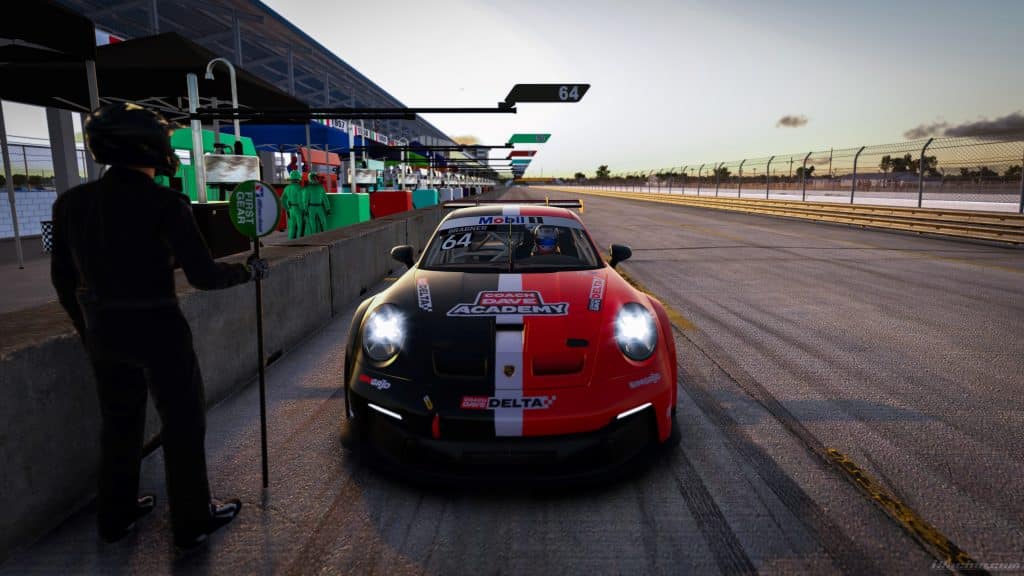
Unlike its 992 GT3.R sibling, the 992 GT3 Cup is built from the outset to race against other similar machines, rather than in a mixed class. In iRacing, the vehicle doesn’t come with either ABS or TC, making it harder to be consistent with over a stint. It also produces less downforce and power than the GT3 car, meaning it’ll also be slower over a full lap.
The GT4 Class
The GT4 class currently consists of five vehicles in the service and is the category slotting in between the Porsche Cup and TCR vehicles in terms of lap speed. The GT4 regulations force the cars to be built very closely to their road-going counterparts, meaning they share very similar powertrains.
Compared to their more capable GT3 cousins, GT4 vehicles produce very little downforce, so they rely primarily on mechanical grip from the suspension setup and tyres to make their lap time. They do feature both TC and ABS systems, so are relatively easy to control under braking and acceleration.

| Car | Key technical characteristics |
| Aston Martin Vantage GT4 | Front-engined layout, turbocharged 4.0-litre V8 |
| BMW M4 GT4 | Front-engined layout, turbocharged 3.0-litre straight-six |
| Porsche 718 Cayman GT4 Clubsport | Mid-engined layout, naturally-aspirated 3.8-litre flat-six |
| McLaren 540S GT4 | Mid-engined layout, twin-turbocharged 3.8-litre V8 |
| Mercedes-AMG GT4 | Front-engined layout, biturbo 4.0-litre V8 |
The TCR Class
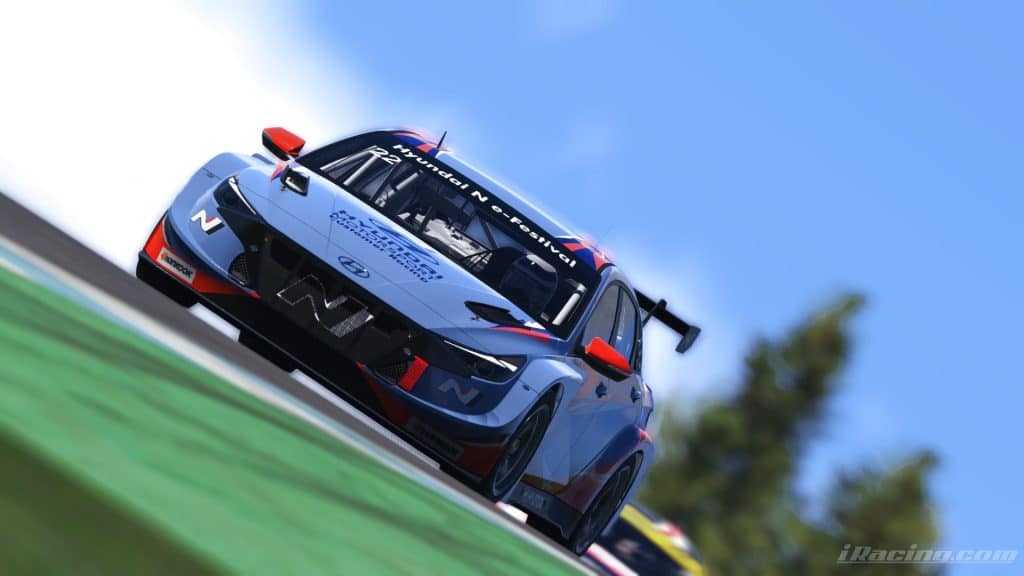
The next category you’ll be sharing the track with is the TCR class. Made up of four different vehicles for the 24 Hours, these front-wheel-driven machines all feature two-litre turbocharged engines.
Like the GT4s, these cars feature very little in the way of downforce and are set up to be as loose at the rear as possible. This helps rotate the vehicle as the driver can’t use the rear wheels to help turn the car and also helps to save the front tyres by taking some of the pressure away from them.
| Car | Key technical characteristics |
| Honda Civic Type R | Front-wheel drive, Front-engined layout, turbocharged 2.0-litre inline-four |
| Hyundai Elantra N TC | Front-wheel drive, front-engined layout, turbocharged 2.0-litre inline-four |
| Hyundai Veloster N TCR | Front-wheel drive, Front-engined layout, turbocharged 2.0-litre inline-four |
| Audi RS3 LMS TCR | Front-wheel drive, Front-engined layout, turbocharged 2.0-litre inline-four |
Race Format and Strategy
The grid for each split will decided by one of iRacing’s customary qualifying sessions that run over eight minutes and grant two fast laps. One driver from each team must be designated to qualify the car, though the driver who takes the start can be different from the one that qualifies. The race will then get underway with a rolling start procedure.
Track Conditions
The Nurburgring 24-Hour event features dynamic weather, so the grip from the road available to you will change as the race develops. The level of cloud cover can greatly affect the level of grip on the tarmac, so you need to have your wits about you. With the groundbreaking introduction of rain to the iRacing service with the 2024 Season 2 update, you might just have to keep your eye on the weather radar, too.
Track grip will also increase throughout the race as rubber is laid down, which will affect tyre wear and potentially the car balance.
- Making sure race runs have been completed in different conditions is key, as you can make decisive – and correct – tyre pressure and general setup tweaks as the weather shifts
- Car balance can shift significantly if not done properly, potentially reducing raw pace and driver confidence
- A close eye must be kept on track temperatures, as you will need to alter your driving style to get the most grip and life from the tyres as the temps change
Consistency
Consistency is a crucial ingredient to scoring a good result in a long-distance race, as without this element your car likely won’t make it to the end in the same condition it started it. That is even more important in the Nurburgring 24 hours.
- Establishing a strong rhythm means you’ll be less likely to make a mistake, as you’re keeping the car nicely within its limit – remember slower is frequently faster!
- The less consistently you drive, the more likely you are to not be looking after the tyres/brakes, costing you speed at the back end of each stint
If you feel you need to brush up on your driving technique, why not take a look at Coach Dave Academy’s brand new Never Lift guide, which is full of driving tips that will help you get the very most out of yourself out on track?
Race Variables
Being a multi-class event means you will need to take care of faster or slower classes that you share the track with.
- Try to leave as many moves as possible until the straights as this mitigates risk, though due to the tight nature of the circuit, this is difficult
- Position your car clearly on the side of the circuit you wish to overtake, though bear in mind the slower car should always remain on the racing line
- The pace differential between GT3 and Porsche Cup is fairly small in some areas, so thinking well ahead of a passing attempt will pay dividends
- It’ll be harder to get into a rhythm in a multi-class race due to always having to watch your mirrors or navigate slower traffic, so remaining calm and decisive in your driving will help your final result
Being able to apply these elements to your race craft will ensure that you have the best possible chance of out-thinking the competition across a stint, leading to a better race finish.
Keeping the car clean and in a competitive condition for the opening 20 hours or so will prove critical to the final result, endurance victories are rarely decided before this point! Beyond this marker, any remaining performance must be maximised to ensure you’re team is in the best position to secure a great result.